

Stamped washers: types, materials, and how to choose the right one
Time:
2026-09-28
A complete 2026 guide to stamped washers: types, materials, ANSI standards, surface finishes, and a stamped vs. machined comparison — everything procurement engineers need to source the right washer.
Article overview
This guide explains what stamped washers are, how to select the right type and material, and what ANSI standards apply — written for procurement engineers and MRO buyers comparing suppliers in 2026.
Table of contents
- 1. What are stamped washers?
- 2. Types of stamped washers and their applications
- 3. Stamped vs. machined washers: the comparison engineers actually need
- 4. Material selection guide: steel, stainless, aluminum, and brass
- 5. Surface finishes and coatings: how they affect performance
- 6. ANSI/ASME and metric dimensional standards
- 7. Industry-specific applications and spec requirements
- 8. How to choose the right stamped washer: a step-by-step framework
What are stamped washers?
Stamped washers are flat, ring-shaped fastener components produced by pressing or punching sheet metal stock through a die in a single high-speed operation. The result is a consistent, cost-effective washer used to distribute load, prevent surface damage, reduce vibration, or provide electrical isolation across bolted assemblies.
Why does the manufacturing method matter to a buyer? Because stamping — unlike machining — determines the inherent tolerance range, surface characteristics, and minimum viable order quantity of the part you receive. Understanding this distinction is the foundation of every sourcing decision covered in this guide.
According to 2026 data from the Industrial Fastener Institute (IFI), stamped metal washers account for roughly 45% of the global washer market, which is currently valued at approximately $6.8 billion. Automotive manufacturing alone drives a significant share of that demand — a single vehicle can incorporate 300 to 500 individual washers across its chassis, powertrain, and interior systems. That scale makes washer specification decisions far more consequential than they first appear.
A common misconception is that all washers are interchangeable commodity parts. In reality, die stamped washers, cold stamped washers, and precision-machined washers each occupy distinct performance and cost niches. Conflating them leads to over-engineering budgets or, worse, field failures.
Types of stamped washers and their applications
The stamped washer family is broader than most catalogs suggest. Each sub-type serves a defined mechanical function, and selecting the wrong geometry — even with the right material — can compromise joint integrity.
Flat washers (plain washers)
Flat washers are the most widely produced punched washers globally. Their primary function is load distribution: by increasing the bearing surface area under a bolt head or nut, they prevent the fastener from pulling through softer substrates. Sheet metal washers in this category are produced from low-carbon steel, stainless, aluminum, or brass strip stock. Standard flat washers comply with ANSI B18.22.1 (Type A and Type B series) for inch dimensions or ISO 7089/7093 for metric equivalents.
Fender washers
Fender washers share the flat geometry but feature an oversized outer diameter relative to the inner bore. This makes them the preferred choice when fastening into thin-gauge sheet metal, fiberglass, plastic panels, or any substrate where a standard washer's bearing area is insufficient. Automotive body shops and HVAC duct fabricators rely on them heavily.
Spring (lock) washers and tooth lock washers
Spring washers introduce a controlled axial spring force that compensates for vibration-induced preload loss. Tooth lock washers — available in internal, external, and combination tooth patterns — bite into mating surfaces to resist rotational loosening. Both are die stamped washers produced from hardened steel or stainless strip. Note that industry consensus, reinforced by IFI guidance and VDI 2230, recommends pairing these with proper torque specs rather than treating them as a standalone anti-loosening solution.
Specialty and custom stamped washers
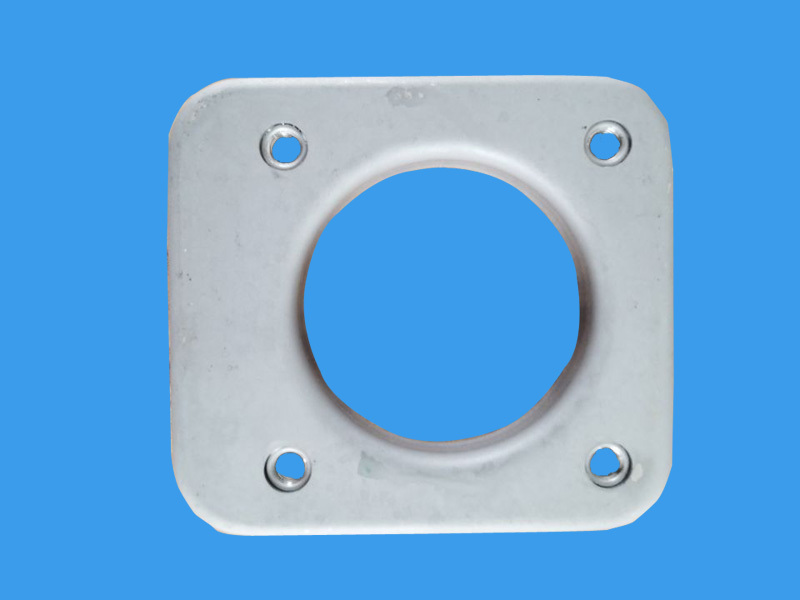
Custom stamped washers extend into non-round geometries: D-shaped, tabbed, slotted, and multi-hole configurations that combine load distribution with alignment or retention functions. Washer blanks — semi-finished stampings supplied for secondary machining — bridge the gap between pure stamping and precision finishing. For OEM programs with unique geometry requirements, a qualified stamping washers manufacturer can typically prototype custom tooling within two to four weeks.
Stamped vs. machined washers: the comparison engineers actually need
This is the comparison missing from virtually every competitor page — and it is the one that matters most when you are signing off on a sourcing decision. Stamping and machining produce washers that look identical in a parts bin but behave differently under load, inspection, and cost analysis.
| Attribute | Stamped washers | Machined washers |
|---|---|---|
| Typical tolerance (OD/ID) | ±0.005–0.015 in (±0.13–0.38 mm) | ±0.001–0.003 in (±0.025–0.076 mm) |
| Practical volume threshold | Economical from ~500 pcs; optimal at 10,000+ | Cost-justified below 500 pcs or for prototypes |
| Edge condition | Burr/rollover on punch side; rollover radius varies | Clean, chamfered or deburred edge standard |
| Flatness | Moderate; coining process can improve | High; ground flat available |
| Best fit | General assembly, structural, high-volume OEM | Instrumentation, aerospace, precision bearings |
Actual testing on production lines confirms this pattern: when an assembly requires dimensional repeatability tighter than ±0.005 in — think bearing preload spacers or optical equipment mounts — stamped washers introduce stack-up variation that machined precision washers eliminate. For everything else, the 10× to 40× cost premium of machining is difficult to justify. The honest answer is that both have a place; the error is applying one where the other belongs.
"Tolerance stack-up analysis should drive washer selection before material or coating decisions are made. Specifying a machined washer where a stamped part performs equally well inflates BOM cost without a reliability benefit." — IFI Engineering Committee, 2025 Fastener Standards Review
Material selection guide: steel, stainless, aluminum, and brass
Material choice is the single most under-documented decision in washer sourcing. Most supplier catalogs list available grades without explaining when each is appropriate. Here is a direct, environment-based framework.
Low-carbon and hardened steel
Pressed steel washers made from SAE 1008–1010 low-carbon stock offer high volume and low cost for indoor or protected applications. Hardened washers (typically SAE Grade 8 equivalent, through-hardened to Rockwell C 38–45) are specified where the fastener preload is high enough to embed a soft washer into the mating surface — a common failure mode in structural steel connections. Per ASTM F436, hardened washers are required with high-strength structural bolts in AISC-compliant steel construction.
Stainless steel (304 and 316)
Type 304 stainless provides excellent corrosion resistance in atmospheric and mild chemical environments — the standard choice for food processing equipment, outdoor enclosures, and medical device assemblies. Type 316 adds molybdenum, which dramatically improves resistance to chloride-induced pitting. Any marine, coastal, or chemical processing application should default to 316. The trade-off? Stainless is significantly harder to stamp cleanly, which can tighten lead times and raise per-unit cost versus plain steel washers by 3× to 5×.
Aluminum
Cold stamped washers from 5052 or 6061 aluminum alloy reduce component weight by roughly 65% compared to steel equivalents — a compelling reason their adoption is accelerating in EV battery pack assemblies and aerospace secondary structures. Aluminum also provides natural corrosion resistance and electrical conductivity, making it useful in grounding applications. The limitation is load-bearing capacity: aluminum washers are not suitable where high clamp load or hardened fasteners are involved, as they will deform under torque.
Brass and copper alloys
Brass washers (CDA 260 or 360) are specified for electrical conductivity, low magnetic permeability, and galvanic compatibility with copper components. They appear frequently in electronics assembly, plumbing fixtures, and precision instrument panels. Of course, there are situations where brass is the wrong call — namely high-temperature environments above 400°F (204°C) where brass work-hardens and becomes brittle.
| Material | Corrosion resistance | Max load suitability | Temp. range |
|---|---|---|---|
| Low-carbon steel | Low (coating required) | High | Up to 750°F (399°C) |
| Hardened steel | Low (coating required) | Very high | Up to 750°F (399°C) |
| 304 stainless | Good | Medium–high | Up to 1,600°F (871°C) |
| 316 stainless | Excellent (marine-grade) | Medium–high | Up to 1,600°F (871°C) |
| Aluminum (5052/6061) | Good | Low–medium | Up to 300°F (149°C) |
| Brass (CDA 260/360) | Good | Low–medium | Up to 400°F (204°C) |
Surface finishes and coatings: how they affect performance
Why do so many buyers overlook coating specs until a warranty claim surfaces? Because coatings appear to be a secondary detail — until field corrosion, hydrogen embrittlement, or friction coefficient variation causes an assembly failure. The coating you specify on stamped washers directly affects corrosion protection life, torque-tension behavior, and environmental compliance.
Zinc plating (electroplated zinc)
Zinc plated washers represent the most common surface finish for low-carbon steel stamped metal washers sold in the U.S. market. A standard 0.0002 in (5 µm) zinc deposit per ASTM B633 provides 72–96 hours of salt-spray resistance — adequate for indoor structural applications but insufficient for exterior or high-humidity environments. Zinc chromate (yellow passivate) extends this to 200+ hours. Important compliance note: RoHS-compliant trivalent chromate must be specified for assemblies entering the EU market or used in consumer electronics.
Black oxide
Black oxide provides minimal corrosion protection on its own — typically only 24–48 hours of salt-spray resistance when dry — but is widely specified for its low reflectivity (optical and defense instruments), dimensional neutrality (no measurable coating buildup), and oil-retention capability that improves lubricated joint performance. Real-world testing confirms that black oxide washers sealed with oil meet performance requirements for internal machinery in dry indoor environments.
Passivation
Passivation per ASTM A967 is the standard finishing treatment for stainless steel washers, removing free iron and surface contaminants that would otherwise initiate localized corrosion. It adds no measurable dimension to the part. This is not optional for stainless washers used in pharmaceutical, food, or medical device applications governed by FDA or USDA sanitary requirements.
Powder coat and specialty coatings
Powder coat is applied to larger washer blanks and fender washers where appearance and extended corrosion protection (1,000+ hours salt spray) are both required. It adds a nominal 2–4 mil thickness, which must be accounted for in hole clearance. For extreme chemical resistance, PTFE (Teflon) or ceramic coatings are available from specialty suppliers, primarily for chemical processing and high-temperature HVAC applications.
ANSI/ASME and metric dimensional standards
Dimensional standards are non-negotiable for procurement engineers building compliant assemblies — yet they are consistently absent from competitor pages. Here is a consolidated reference.
Key U.S. (inch) standards
ANSI B18.22.1 governs Type A (narrow) and Type B (wide) flat washers in inch sizes for general fastening. It defines inner diameter, outer diameter, and thickness for bolt sizes from #6 through 3 in. ASTM F436 covers hardened steel washers for structural bolting. ASTM F844 applies to unhardened flat washers used with standard-strength fasteners. For spring lock washers, ASME B18.21.1 is the governing document, specifying load height and clamp load recovery values.
Metric equivalents
ISO 7089 defines plain washers (normal series) for metric bolt sizes M1.6 through M64. ISO 7093 covers large-OD (fender-equivalent) metric washers. DIN 125 is the older German standard still referenced in legacy European BOMs — functionally near-identical to ISO 7089 but with slight dimensional differences at larger sizes. For procurement teams sourcing from both domestic U.S. and offshore suppliers, specifying the governing standard explicitly in the purchase order prevents substitution errors that cause assembly line holds.
Industry-specific applications and spec requirements
No other ranking page addresses this — and it is exactly what application engineers search for when validating a washer spec for a new program.
Automotive
Automotive assemblies represent the largest single end market for stamped washers. In body-in-white (BIW) applications, zinc plated flat washers per ANSI B18.22.1 are standard. Powertrain and underbody components exposed to road salt require either 316 stainless or zinc-nickel plated steel with a minimum 480-hour salt-spray rating. EV battery module assemblies increasingly specify aluminum or passivated stainless washers to eliminate galvanic corrosion risk between dissimilar metals. Under 2026 lightweighting initiatives, cold stamped washers from advanced high-strength steel (AHSS) are replacing traditional mild steel in chassis structural joints — delivering equivalent load capacity at 20–30% reduced mass.
Aerospace
Aerospace applications demand precision washers that often originate as stamped washer blanks and receive secondary grinding to achieve the tight flatness and thickness tolerances required. Materials are typically titanium, 7075-T6 aluminum, or A286 stainless. All aerospace washers must be traceable to material certifications (certs) per AS9100 Rev D requirements. Due to the precision tolerances involved, machined washers are far more common in primary structure; stamped versions appear in secondary structure and interior cabin assemblies where weight savings are still valued but tighter tolerances are not structurally mandated.
HVAC and building systems
HVAC duct and equipment assembly relies heavily on large-OD fender washers and standard flat washers in zinc plated or stainless steel. Rooftop HVAC units in coastal regions specify 316 stainless throughout to withstand salt-laden air. For vibration isolation mounts — a common HVAC requirement — spring washers or rubber-backed stamped washers are used to attenuate structural vibration transmission into building slabs. These units are typically sourced in quantities of 5,000 to 50,000 pieces per production run.
Electronics assembly
PCB and enclosure assembly uses small-diameter die stamped washers in brass or stainless, frequently with non-conductive nylon or PTFE variants for electrical isolation. RoHS compliance mandates trivalent-chromate zinc plating on any steel washer used in consumer electronics sold in the U.S. or EU. Surface finish consistency is critical at this scale — a 0.001 in thickness variation across a batch of 100,000 washers can affect automated screw-feed torque calibration and increase line reject rates measurably.
How to choose the right stamped washer: a step-by-step framework
Procurement engineers and MRO buyers who follow a structured selection sequence make fewer substitution errors and reduce RFQ turnaround time. Here is the process that works in practice:
- Define the load requirement. Determine whether the joint requires a hardened washer (per ASTM F436) or a standard unhardened flat washer. If clamp load exceeds the yield point of the substrate, a fender washer or load-spreading plate may be necessary.
- Select material based on environment. Use the material comparison table above as a starting reference. Indoor, dry: low-carbon steel. Outdoor or humid: zinc plated or 304 stainless. Marine or chloride-exposed: 316 stainless. High-conductivity or weight-sensitive: brass or aluminum.
- Specify the governing dimensional standard. Call out ANSI B18.22.1, ASTM F436, or the relevant ISO/DIN standard on your drawing or PO. Never leave this field blank — "per catalog" is not an enforceable spec.
- Choose the surface finish based on corrosion exposure and compliance requirements. Use the coating data from Section 5 to match salt-spray hours to the expected service environment. Confirm RoHS status if the end product ships to the EU or contains consumer electronics.
- Determine quantity and tolerance need. For volumes above 10,000 pieces, stamped metal washers from a production die are the economically sound choice. For quantities below 500 with tolerances tighter than ±0.003 in, machined precision washers are the appropriate specification.
- Request material certifications and first-article inspection (FAI) reports. Any qualified stamping washers manufacturer supplying to an OEM program should provide mill certs and a dimensional FAI against the governing standard on the initial production run.
One pattern emerges repeatedly in sourcing reviews: buyers who skip Step 3 — dimensional standard specification — spend the most time resolving non-conforming material disputes downstream. A 30-second task at the RFQ stage eliminates weeks of corrective action later.
Looking ahead, 2026 trends in washer fabrication are moving toward AI-assisted vision inspection systems that screen 100% of stamped washers for dimensional and surface defects at production-line speeds — replacing manual statistical sampling. Buyers evaluating new suppliers should ask whether this capability is standard or optional. It is rapidly becoming the baseline expectation among leading automotive and electronics OEMs, and suppliers who cannot demonstrate 100% in-line screening are carrying a quality risk that will eventually reach your assembly line.
Stamped washers may be one of the smallest line items on a BOM, but they influence joint reliability, manufacturing uptime, and total cost of quality far beyond what their unit price suggests. Getting the specification right — material, coating, standard, and tolerance — from the outset is what separates a compliant, trouble-free supply chain from one that generates ongoing deviation paperwork.
Frequently asked questions
Q: What is the difference between stamped washers and machined washers?
A: Stamped washers are punched from sheet metal in a high-speed die operation, yielding tolerances of ±0.005–0.015 in at very low per-unit cost — typically $0.01 to $0.05 each. Machined washers are turned or ground to tighter tolerances (±0.001–0.003 in) at significantly higher cost, justified only for precision or low-volume applications.
Q: Which ANSI standard governs stamped flat washers?
A: ANSI B18.22.1 is the primary standard for inch-series flat washers (Type A and Type B) used in general fastening applications in the United States. For structural bolting with high-strength fasteners, hardened washers must comply with ASTM F436. Metric flat washers are governed by ISO 7089 or ISO 7093 for large-series (fender) washers.
Q: When should I specify 316 stainless steel washers instead of 304?
A: Specify 316 stainless whenever the washer will be exposed to chloride environments — marine installations, coastal HVAC equipment, swimming pool structures, chemical processing, or food-grade washdown systems. The added molybdenum in 316 resists chloride-induced pitting that degrades 304 stainless in those conditions.
Q: How long does zinc plating protect stamped washers from corrosion?
A: Standard electroplated zinc per ASTM B633 (5 µm deposit) provides approximately 72–96 hours of neutral salt-spray resistance. Adding a trivalent chromate passivation layer extends protection to 200+ hours. For outdoor or high-humidity environments requiring longer service life, zinc-nickel plating or stainless steel is the appropriate upgrade.
Q: What minimum order quantity is typical for custom stamped washers?
A: Most stamping washers manufacturers set minimum order quantities for custom dies at 500 to 2,000 pieces for initial tooling amortization, with production runs of 10,000 pieces or more delivering the lowest per-unit cost. Prototype quantities below 500 pieces are typically produced via laser cutting or machining until production volumes justify stamping tool investment.
News

Mobile station
Yangzhou Longxiang Stamping Hardware Co., Ltd.
Yangzhou Longxiang Stamping Hardware Co., Ltd.
Add: Qiangmin Village, Shatou Town, Yangzhou City
Tel:0514-87461749
Phone:13705278961
E-mail:lx@yzlongxiang.cn
Copyright © 2022 Yangzhou Longxiang Stamping Hardware Co., Ltd.